
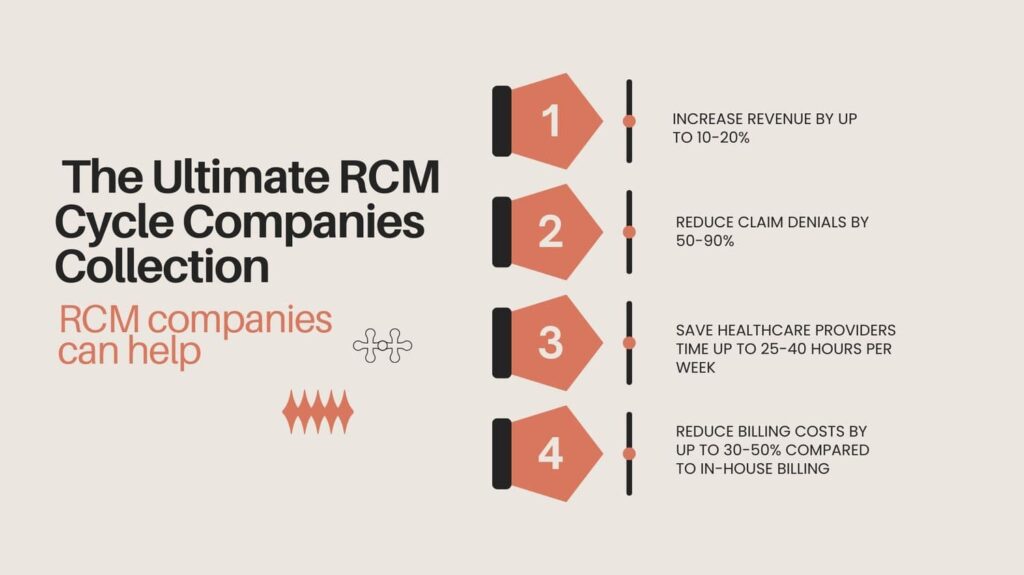
With the increasing demand for medical billing in healthcare, some of the top revenue cycle management companies are operating and providing their RCM services to help you generate greater revenue. Revenue cycle management is a must-implementation strategy by health facilities, that helps them generate revenue faster and manage their cash flow. The cycle involves the entire medical procedure, from patient verification to creating and sending bills. When healthcare providers and hospitals outsource their billing part to professional healthcare revenue cycle management companies, they can grow rapidly and more easily by offloading the extra time-consuming and complex work of claims and collections. RCM firms support healthcare providers and hospitals with reliable RCM solutions tailored to their needs.
But sometimes due to a lack of resources or staff, hospitals opt for collaborating with companies that manage their RCM cycle by implementing the suitable strategies.
If you too are a healthcare facility and want to know which company to choose for your RCM needs, look no further. As our guide has collected more than 170 companies that you can consider working with in 2026.
However, besides picking the best RCM cycle company there are other things that you must consider before collaborating with them.
Why it is essential to hire top RCM companies when you could carry out medical coding yourself?
The answer is that you must rely on professional hospital revenue cycle management companies to execute medical billing and coding as any minor mistake can lead to the claims being rejected by the payer, which in turn, weakens your financial stability.
Healthcare revenue cycle management companies can deal with the entire revenue generation process, so you can focus on other responsibilities besides getting your revenue.
In fact, HFMA conducted a survey in 2023, where they found that hospitals collaborating with RCM firms experienced 8% yearly revenue increase from the last 3 years, which was 6% more than conducting in-house billing.
So why not try these companies out?
Why Do Most Healthcare Outsource Their RCM Cycle?
Ever wonder why large practices despite containing extensive staff, still outsource their RCM to other firms?
The reason behind this is that medical bill and claim management should be conducted in a careful way, as it determines the reimbursement rejection or approval.
Hence, healthcare facilities that have a large patient base, outsource RCM cycle to avoid hard work. This way they can focus on other important health tasks to upscale their services.
Let’s compare outsourced RCM processes versus managing them in-house.
| Aspect | Outsourcing RCM | In-House RCM |
| Cost | Fixed monthly fees, potential cost savings | Higher initial investment, ongoing expenses |
| Expertise | Access to specialized skills and knowledge | Direct control over staff and processes |
| Scalability | Ability to scale services based on needs | Limited scalability without additional resources |
| Control | Less control over processes and workflows | Full control over operations and decision-making |
| Focus | Allows focus on core healthcare operations | Requires allocation of resources to RCM tasks |
Besides all this, there are some other benefits as well that healthcare facilities acquire when handover their RCM cycle to a company:
Error Reduction
Managing claims in-house multiplies the chances of containing claim errors, that result in claim denials and eventually revenue loss. That’s where RCM cycle companies come in.
They prepare and send claims incorporating accurate guidelines of insurance payers, that are more likely to be accepted.
Also, they keep a regular follow-up with the claim application so that they can remove any payer objection ASAP and help you generate quick revenue.
Technology Implementation
To conduct the RCM cycle effectively, modernized systems are used, which some health facilities can’t afford.
Additionally, keeping up with evolving RCM trends can be a daunting task for hospitals, and if ignored can lead to decreased financial stability.
Your Journey to RCM Brilliance Starts with a Simple Click—try it Today.
RCM companies take up your duties. They have already such systems and technology installed in their procedures that help them perform proficient revenue cycle management.
Training Hustles
Each health facility operates differently. When they hire the new staff they have to conduct proper training to let employees know how the system works.
However, if you don’t have time and training programs available in your hospital, go for RCM cycle companies. As they have already trained, skilled and professional teams that transform each of your claims into complete revenue.
Claim Tracking
Claim applications once created and sent must be reported regularly. This reporting helps identify denial patterns that assist in better future performance.
If you can’t keep a regular record and want to focus on other health areas, RCM cycle companies do that too.
Due to their experience, they already know how to manage claim applications. They avoid past mistakes that led to claim denials, and based on your data, they prepare future claims with full accuracy.
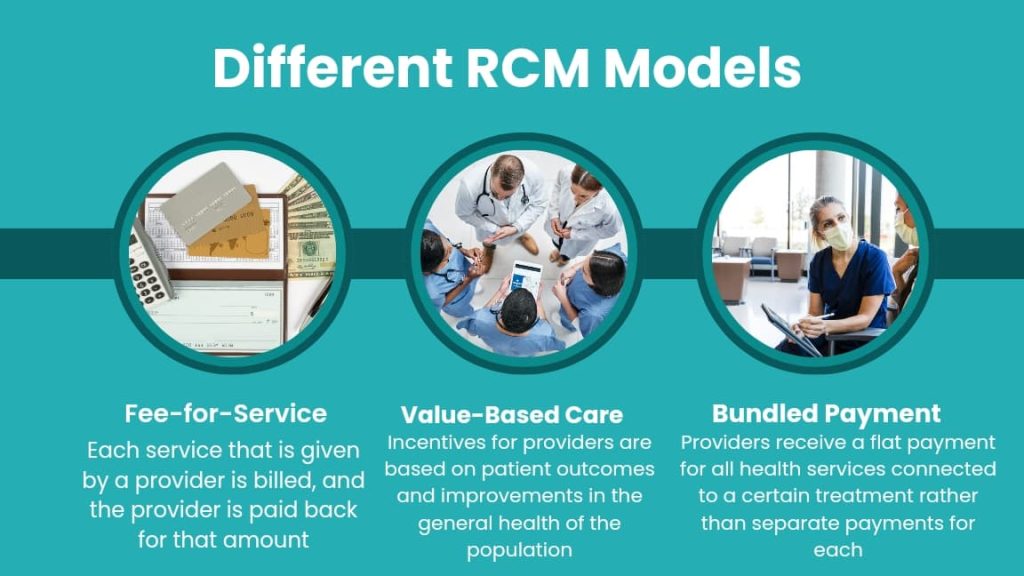
Different RCM Models
Revenue cycle management ensures that healthcare providers’ financial operations run smoothly in the constantly changing environment. RCM is the process of overseeing the financial facets of patient care, from claim filing and payment to registration and billing.
To build payment agreements and reimbursement processes within RCM, many models are used. In order to maximize financial results, let’s examine the various RCM models:
Fee-for-Service Model
One of the classic methods of paying for healthcare is the fee-for-service model. The services that healthcare practitioners offer to patients determine how much they are compensated under this paradigm.
Each service, whether a visit to the doctor, an operation, or a diagnostic test, has a set cost. Each service that is given by a provider is billed, and the provider is paid back for that amount.
| RCM Model | Size of Practices |
| Fee-for-Service | Small to medium-sized practices, independent physicians. |
| Value-Based Care | Larger practices with established care coordination teams. |
| Bundled Payment | Specialized practices or facilities focusing on specific treatments or procedures. |
| Outsourced RCM | Small practices with limited administrative resources, often preferred by startups and solo practitioners. |
| In-house RCM | Larger practices or healthcare systems with dedicated billing departments and infrastructure. |
| Hybrid RCM | Medium to large practices combining in-house and outsourced RCM services for flexibility and control. |
Value-Based Care Model
Value-based care is a more recent RCM approach that places more emphasis on the standard of care given to patients than on the volume of services delivered.
According to this paradigm, incentives for healthcare providers are based on patient outcomes and improvements in the general health of the population they serve.
Through preventative treatment and efficient disease management, the objective is to improve patient outcomes and save healthcare expenditures.
Bundled Payment Model
A single payment is paid to healthcare providers under the bundled payment model for a full episode of care. Providers receive a flat payment for all services connected to a certain treatment rather than separate payments for each service.
This model seeks to advance cost-effectiveness and care coordination.
RCM Companies Can Save You Cost At…
Companies that specialize in revenue cycle management, or RCM, are essential in assisting healthcare providers with effective financial management.
Let’s examine how RCM businesses can help you save money on numerous fronts in your medical practice.
1. Efficient Billing and Claims Processing
The Healthcare Financial Management Association (HFMA) conducted research that found that RCM firms can cut back on billing and claims processing errors by up to 50%.
This degree of effectiveness guarantees timely claim filing, resulting in quicker insurance company payments and saving your practice important time and money.
2. Reducing Claim Denials and Rejections
According to the American Medical Association (AMA), a healthcare practitioners may lose 5–10% of their annual revenue as a result of claim denials.
Insurance laws and regulations are a specialty of RCM cycle firms. They can prevent denials and rejections by thoroughly evaluating claims, thus protecting your practice from lost revenue.
3. Optimizing Revenue Collection
Medical Group Management Association (MGMA) study results show that RCM firms have assisted healthcare providers in increasing their revenue collection by an average of 15-20%.
RCM businesses make sure that your practice receives the money it is due by tracking down unpaid or underpaid claims and spotting payment anomalies.
4. Identifying and Correcting Coding Errors
According to the Journal of AHIMA (American Health Information Management Association), coding errors might result in a 10% revenue loss.
The expert coders used by RCM businesses meticulously analyze medical paperwork to ensure accurate coding and reduce revenue loss brought on by coding-related problems and compliance mistakes.
5. Improving Patient Payment Processes
According to a study in the Journal of Medical Practice Management, providing patients with convenient payment choices can improve patient payments by 30%.
To make it simpler for patients to pay their bills and lessen the stress of unpaid patient balances, RCM businesses offer online payment portals and convenient and flexible payment plans.
6. Minimizing Administrative Costs
According to the Medical Group Management Association (MGMA), healthcare organizations can save their administrative costs by up to 30% by outsourcing RCM services to specialized businesses.
You can save money by utilizing the knowledge and resources of RCM cycle businesses rather than spending money on pricey software or hiring more people just to handle billing and revenue management duties.
7. Enhancing Financial Predictability
Healthcare providers who partnered with RCM businesses reported a 20–30% increase in financial predictability, according to a RevCycle Intelligence survey.
RCM firms help you predict your cash flow more precisely, making it simpler to plan and make investments in the expansion of your practice. They do this by optimizing revenue collection and automating billing procedures.
Separate Healthcare RCM Settings
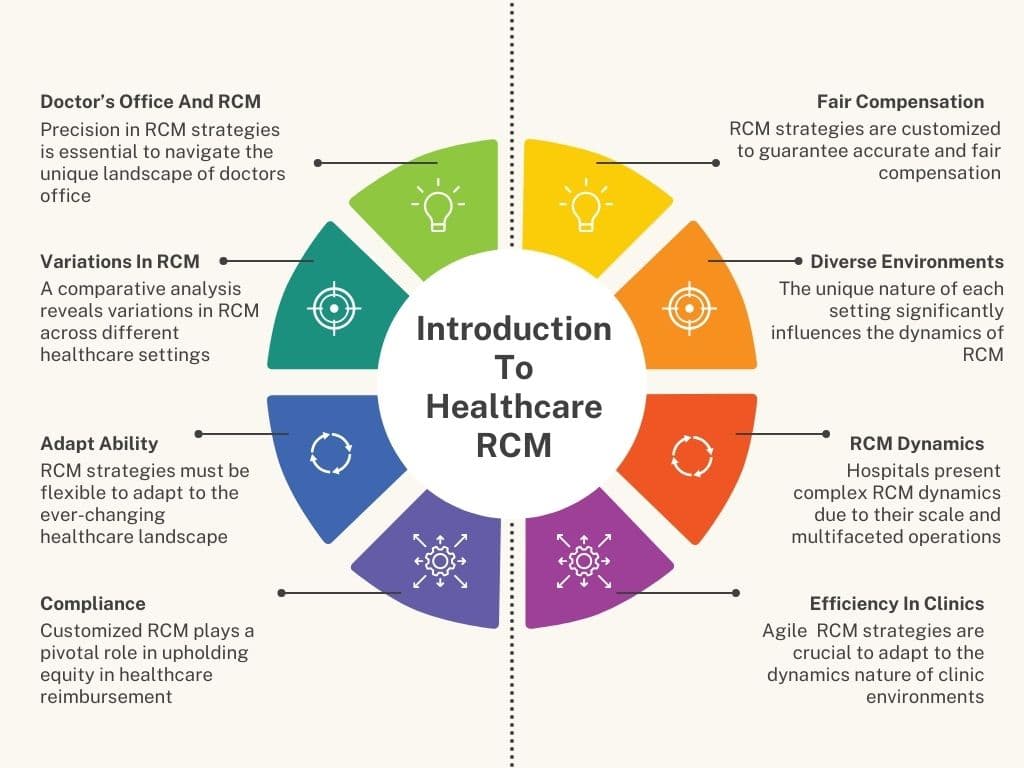
In order to guarantee that healthcare professionals are fairly compensated for their services, revenue cycle management (RCM) is an essential procedure.
RCM is not a one-size-fits-all strategy, though. The healthcare environment, such as hospitals, clinics, and doctor’s offices, has a substantial impact on it.
Let’s talk about the variations in revenue cycle management (RCM) across these various healthcare settings and how it works for each.
RCM for Hospitals
Hospitals deal with a variety of services and complex patient problems, necessitating a strong and thorough approach to RCM.
Coordination is crucial since hospital billing and coding procedures include numerous departments and service lines. To maximize healthcare revenue capture, RCM places a strong emphasis on swift claims processing, precise coding, and detailed documentation.
Furthermore, hospitals frequently have increased claim denials because of the volume and complexity of the services they offer, making denials management essential.
For the purpose of maximizing revenue collection, RCM teams concentrate on prompt claim follow-up and appeals.
Want to Know the Benefits of Hiring RCM Companies? Begin by clicking the Button.
RCM for Clinics
Whether specialized or broad, clinics frequently cater to a particular patient demographic. It can provide a more constrained range of services than hospitals.
RCM for clinics emphasizes patient involvement and open billing. Efficiency in claim filing and payment posting is essential given that clinics frequently manage a higher volume of outpatient appointments.
To increase patient satisfaction, RCM teams in clinics place a high priority on prompt patient billing.
They provide a variety of payment choices. As a result of clinics’ smaller size compared to hospitals, RCM may be less complicated, making it easier to administer for internal teams or outside RCM services.
RCM for Physician Practices
In comparison to hospitals and clinics, physician practices may serve a smaller patient population. They usually concentrate on providing specialized medical care.
RCM for physician practices entails close collaboration between medical staff and the billing department. For timely reimbursement and to avoid claim denials, accurate billing and coding are crucial.
To reduce administrative burdens and improve revenue collection, many medical practices outsource their RCM to top revenue cycle management companies.
To maintain a steady cash flow, RCM teams for medical practices frequently concentrate on personalized patient billing and diligent follow-up.
Top RCM Vendors
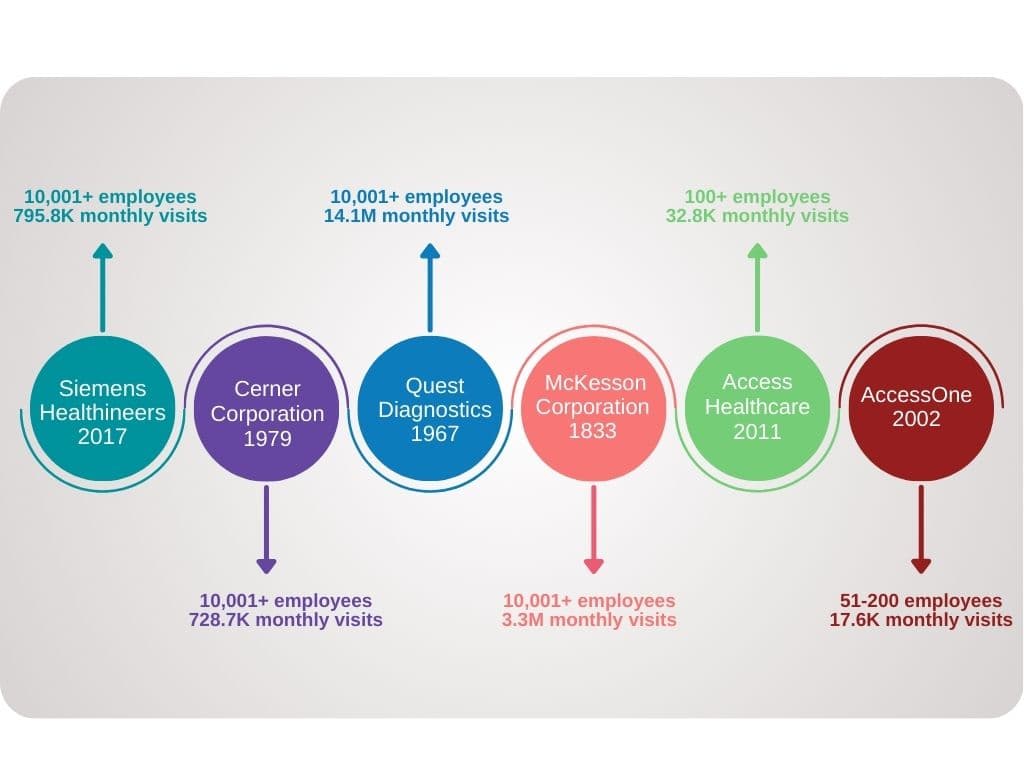
Here are 16 of the top revenue cycle management companies that we have picked along with defining their location, staff quantity, and revenue generated in the past.
General Electric Company
Location: Boston Staff
Quantity: 168,000
Past Revenue: $74.196 Billion
The General Electric Company (GE) is a global leader in various industries, including healthcare. With a substantial staff size and a proven track record of generating significant revenue, GE has established itself as a trusted partner in revenue cycle management.
Their expertise spans across the entire RCM process, from accurate coding and claims submission to effective denial management and revenue optimization.
Siemens Healthineers
Location: Erlangen
Staff Quantity: 66,000
Past Revenue: $22.32 Billion
Siemens Healthineers is renowned for its cutting-edge technologies and solutions in the healthcare industry. With a sizable staff and impressive revenue figures, they bring a wealth of expertise to the field of revenue cycle management.
Siemens Healthineers offers comprehensive RCM services that encompass coding accuracy, claims processing, and revenue optimization.
Their advanced technology platforms and analytics capabilities enable healthcare organizations to streamline their RCM processes, reduce denials, and enhance financial outcomes.
Epic Systems
Location: Verona
Staff Quantity: 10,000
Past Revenue: $2.9 Billion
Epic Systems is a leading provider of healthcare software solutions, including its renowned electronic health record (EHR) system. While they primarily specialize in EHR technology, Epic Systems also offers robust revenue cycle management services.
With a dedicated team and a focus on seamless integration between clinical and financial workflows, Epic Systems ensures accurate coding, efficient claims processing, and improved revenue capture.
Their user-friendly interface and comprehensive reporting capabilities empower healthcare organizations to monitor their revenue cycle performance and make data-driven decisions for continuous improvement.
Cerner Corporation
Location: Kansas City
Staff Quantity: 29,000
Past Revenue: $5.7 Billion
Cerner Corporation is a trusted name in the healthcare IT industry, offering a wide range of solutions to support various aspects of healthcare operations.
Their expertise extends to revenue cycle management, where they provide comprehensive services designed to optimize financial performance.
Their integrated approach allows for seamless coordination between clinical and financial systems, enhancing efficiency and ensuring accurate reimbursement.
Quest Diagnostics
Operates Nationwide
Staff Quantity: 47,000
Past Revenue: $7.73 Billion
Quest Diagnostics is a nationwide leader in diagnostic testing and clinical laboratory services. While their primary focus is on laboratory testing, they also offer revenue cycle management services to healthcare organizations.
With a vast network of laboratories and a substantial workforce, Quest Diagnostics brings extensive experience in managing billing processes and maximizing revenue.
Their RCM solutions encompass accurate coding, efficient claims submission, and proactive denial management.
McKesson Corporation
Location: Texas
Staff Quantity: 78,000
Past Revenue: $263.97 Billion
McKesson Corporation is a prominent player in the healthcare industry, offering a wide range of services and solutions to healthcare organizations.
With a significant staff size and impressive revenue figures, McKesson Corporation has established itself as a trusted partner in revenue cycle management.
They provide comprehensive RCM services, including accurate coding, claims management, denial prevention, and revenue optimization.
Through its advanced technology platforms and analytical capabilities, McKesson Corporation helps healthcare providers streamline their revenue cycle, reduce inefficiencies, and enhance financial performance.
Accenture
Location: Dublin
Staff Quantity: 721,000+
Past Revenue: $50.53 Billion
Accenture is a global professional services company that specializes in providing innovative solutions across various industries, including healthcare.
With an extensive staff size and a strong financial track record, Accenture offers comprehensive revenue cycle management services tailored to the unique needs of healthcare organizations.
Their RCM solutions focus on process optimization, data analytics, and technology integration to drive efficiency and maximize revenue.
By leveraging its vast resources and expertise, Accenture enables healthcare providers to navigate the complexities of RCM and achieve sustainable financial growth.
Access Healthcare
Location: Florida
Staff Quantity: 20,000
Past Revenue: $2 Billion
Access Healthcare is a leading provider of revenue cycle management services, dedicated to helping healthcare organizations optimize their financial performance.
With a sizable staff and a focus on process excellence, Access Healthcare offers comprehensive RCM solutions that cover the entire revenue cycle, from patient registration to final reimbursement.
Their expertise in coding, claims management, denial prevention, and revenue recovery enables healthcare facilities to streamline their RCM processes and improve cash flow.
By partnering with Access Healthcare, organizations can benefit from their tailored solutions and industry best practices.
AccessOne
Location: North Carolina
Staff Quantity: 123
Past Revenue: $33.2 Million
AccessOne is a specialized revenue cycle management company that focuses on patient financial engagement and billing solutions.
Their unique approach combines compassionate patient care with innovative technology to optimize revenue collection and improve the patient’s financial experience.
With a dedicated team and a commitment to patient-centric solutions, AccessOne assists healthcare organizations in managing self-pay accounts, providing financial counseling, and optimizing collections.
By partnering with AccessOne, hospitals can enhance patient satisfaction, increase collections, and streamline their revenue cycle.
Abeo
Location: Dallas
Staff Quantity: 121,100
Past Revenue: $4.34 Million
Abeo is a leading provider of revenue cycle management services, specializing in anesthesia billing and practice management solutions. With a strong focus on the anesthesia specialty, Abeo brings deep expertise and tailored solutions to anesthesia providers.
Their comprehensive RCM services encompass coding accuracy, claims management, and revenue optimization specific to the unique challenges of anesthesia billing.
By leveraging their specialized knowledge and innovative technology, Abeo helps anesthesia providers improve revenue capture, reduce administrative burden, and enhance financial performance.
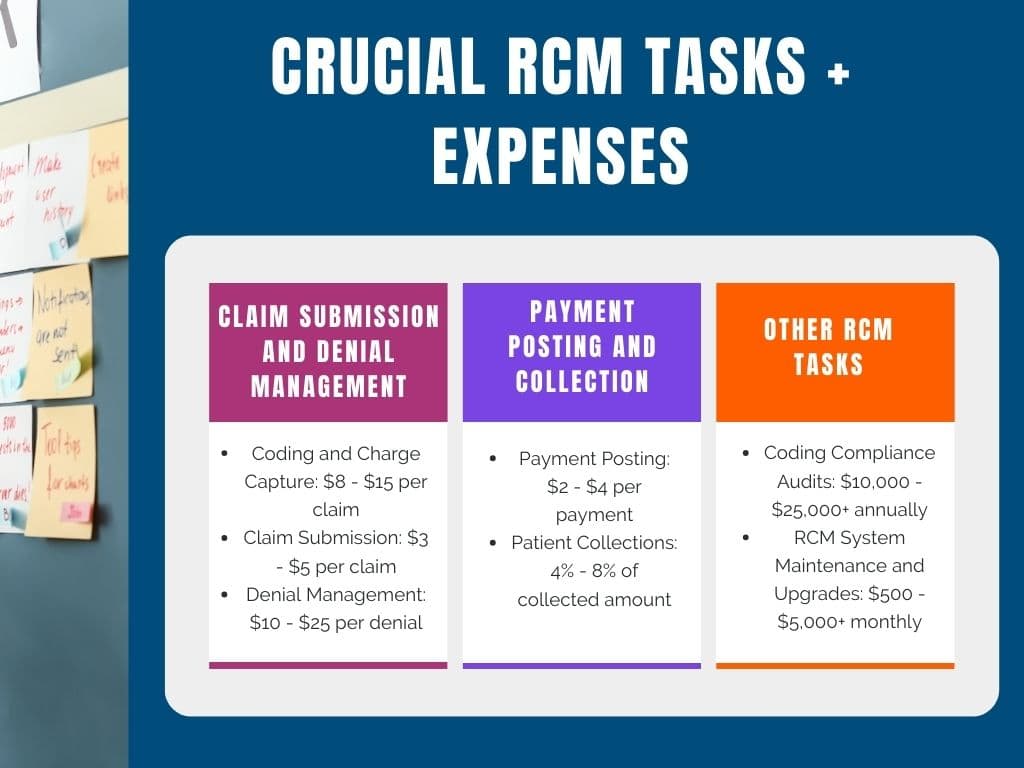
Beyond The 10 Top RCM Companies
Besides the leading RCM organizations, here we would like to provide 6 additional company names because of their remarkable services and popularity in the industry:
1. AthenaHealth
Location: Watertown, MA
Staff Quantity: 7,000
Past Revenue: $2.9 Billion
AthenaHealth is one of the top suppliers of cloud-based applications and services to healthcare providers. Your financial performance, productivity, and efficiency are all enhanced by their solutions.
Over 115,000 healthcare organizations in the US, including hospitals, health systems, and private clinics, use Athenahealth’s products.
2. Medline Industries
Location: Northfield, IL
Staff Quantity: 13,000
Past Revenue: $17.5 Billion
For healthcare providers seeking a one-stop shop for RCM services, medical equipment, and supplies, Medline Industries is a suitable option. They offer top-notch customer service and a broad variety of goods and services.
3. R1 RCM
Location: Irvine, CA
Staff Quantity: 2,000
Past Revenue: $1.0 Billion
R1 RCM is a leading provider of technology-enabled revenue cycle management (RCM) services.
With their solutions, providers may increase their revenue collection, decrease rejections, and streamline their billing procedures, all of which contribute to better financial performance.
4. Parallon
Location: Franklin, TN
Staff Quantity: 2,500
Past Revenue: $1.2 Billion
They provide a full range of services, such as coding, denial management, patient engagement, and claims processing. With the use of Parallon’s solutions, providers can increase their revenue collection, decrease denials, and streamline their billing procedures.
5. Envision Healthcare
Location: Nashville, TN
Staff Quantity: 48,000
Past Revenue: $10.5 Billion
Envision provides a variety of services like anesthesia care, ambulatory surgery, and physician staffing. In addition, Envision Healthcare is a top supplier of revenue cycle management (RCM) services to medical groups, hospitals, and health systems.
6. AGS Health
Location: Brentwood, Tennessee
Staff Quantity: 6900+
Past Revenue: $50 Billion
Offering comprehensive services for RCM, AGS Health provides a strong range of options to maximize each stage of the process. They provide medical coding, denial management, patient financial engagement, and claims processing.
Furthermore, AGS Health makes use of cutting-edge AI tech to spot and fix revenue leakage, guaranteeing that healthcare institutions receive all of the money they are due.
RCM Companies To Consider In 2026
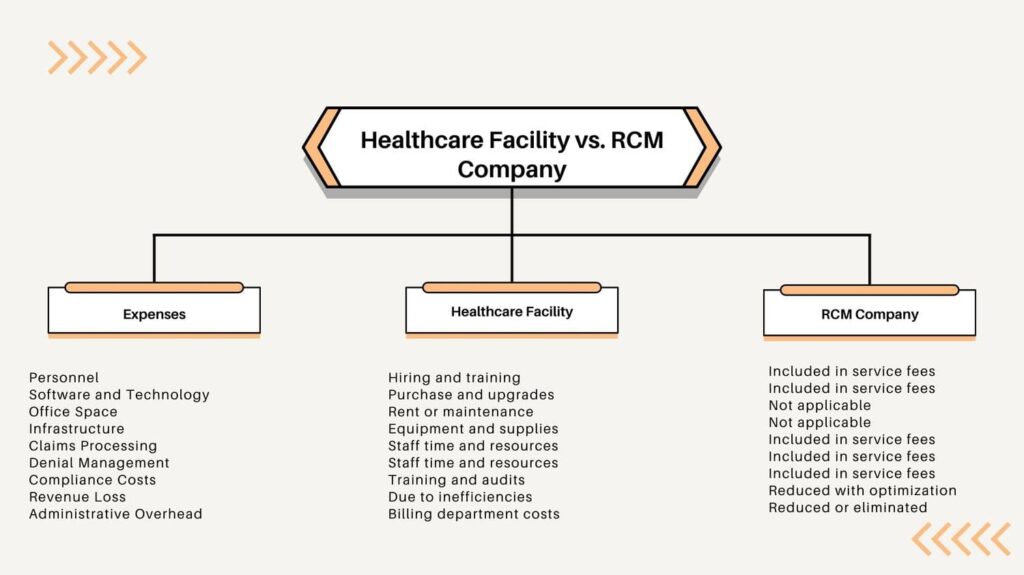
Among a number of RCM cycle management companies, we have compiled the top ones. Based on your location and state, pick any of them:
3M HIS (Salt Lake City)
Abax Health (Westport, Conn.)
Accenture (Dublin, Ireland)
Access Healthcare (Dallas)
Access TeleCare (Dallas)
AccessOne (Charlotte, N.C.)
Accuity (Mount Laurel, N.J.)
AccuReg (Mobile, Ala.)
ACI Worldwide (Naples, Fla.)
AdvantEdge Healthcare Solutions (Lombard, Ill.)
Advantmed (Irvine, Calif.)
Advantum Health (Louisville, Ky.)
Advata Inc. (Bellevue, Wash.)
AGS Health (Washington, D.C.)
AIE Medical Management (Washington, D.C.)
AKASA (San Francisco)
All Right Medical Management Services (Chester, Va.)
Alvaria (Atlanta)
Americollect (Manitowoc, Wis.)
Amitech Solutions (St. Louis)
ANI Healthcare Solutions (San Francisco)
AnnexMed (East Brunswick, N.J.)
Anthro Innovations (Burbank, Ill.)
ApexonHealth (Southfield, Mich.)
ApprioHealth (Washington, D.C.)
Aspirion (Columbus, Ga.)
BC Services (Longmont, Colo)
BDO USA (Chicago)
BillingParadise (Diamond Bar, Calif.)
Boncura Health Solutions (Downers Grove, Ill.)
Cantata Health Solutions (Austin, Texas)
Capio (Lawrenceville, Ga.)
CareCloud (Somerset, N.J.)
CareCredit (Costa Mesa, Calif.)
CarePayment (Nashville, Tenn.)
Cascade365 Family of Companies (Petaluma, Calif.)
CBOSS (Boardman, Ohio)
Cedar (New York City)
Centauri Health Solutions (Scottsdale)
Change Healthcare (Nashville, Tenn.)
Cimcor (Merrillville, Ind.)
CIPROMS (Indianapolis)
Cirius Group (Pleasant Hill, Calif.)
Civxdata (San Diego)
ClaraPrice (Austin, Texas)
ClearBalance (San Diego)
ClinIntell (Seattle)
CodaMetrix (Boston)
CodeOne (Monument, Colo.)
Cognizant RCM (Teaneck, N.J.)
Collect Rx (Bethesda, Md.)
Collection Licenses (Irvine, Calif.)
CommerceHealthcare (Kansas City, Mo.)
Commure (San Francisco)
Commvault (Tinton Falls, N.J.)
Conifer Health Solutions (Frisco, Texas)
DaisyBill (Claymont, Del.)
Dimensional Insight (Burlington, Mass.)
Dolbey (Concord, Ohio)
If You are a Dental Surgeon, We Have Options for You as Well
eCatalyst Healthcare Solutions (Phoenix)
Echelon Medical Capital (Delray Beach, Fla.)
Eclat Health Solutions (Herndon, Va.)
Edifecs (Bellevue, Wash.)
Elevate Patient Financial Solutions MedData (Spring, Texas Houston)
EMPClaims Solutions Inc (Lombard, Ill.)
Enable Healthcare (Hanover, N.J.)
EnableComp (Franklin, Tenn.)
Encore Exchange (Winston-Salem, N.C.)
Ensemble Health Partners (Mason, Ohio)
eSentire, Inc. (Waterloo, Ontario)
Excalibur (Grand Junction, Colo.)
Experian Health (Franklin, Tenn.)
Experity (Machesney Park, Ill.)
Fathom (San Francisco)
FCI/RevCare (Fairlawn, Ohio)
FTI Consulting (Brentwood, Tenn.)
Fathom (San Francisco)
FinThrive (Alpharetta, Ga.).
Finvi (Muncie, Ind.)
Flywire (Boston)
FrontRunnerHC (Plymouth, Mass.)
Frost-Arnett (Nashville, Tenn.)
Fusion Anesthesia Solution (Brookfield, Wis.)
GBS Corp. (North Canton, Ohio)
GeBBS Healthcare Solutions (Culver City, Calif.)
GetixHealth (Sugar Land, Texas)
Global Healthcare Resource (Atlanta)
Global Recovery Alliance AG (Baar, Switzerland)
Grant Thornton (Chicago)
Greenway Health (Tampa, Fla.)
Guidehouse (Chicago)
Hansei Solutions (Franklin, Tenn.)
Harmony Healthcare (Tampa, Fla.)
Harmony Healthcare IT (South Bend, Ind.)
Harris & Harris (Chicago)
Healogics (Jacksonville, Fla.)
Health iPASS, a Sphere Company (Oak Brook, Ill.)
Healthcare Claims Management (Indianapolis)
Healthcare IT Leaders (Alpharetta, Ga.)
Healthcare IP (Edmond, Okla.).
Healthcare Receivables Group (Knoxville, Tenn.)
Healthcare Resource Group (Spokane Valley, Wash.)
HealthPay24 (Mechanicsburg, Pa.)
HealthRise (Southfield, Mich.)
IC System (St. Paul, Minn.)
Imagine Software (Charlotte, N.C.)
Impact Advisors (Naperville, Ill.)
In2itive (Overland Park, Kan.)
Inbox Health (New Haven, Conn.)
Infinx (San Jose, Calif.)
InfoTech Healthcare (Denver)
Ingenious Med (Atlanta)
Innovaccer (San Francisco, Calif.)
Inovalon (Bowie, Md.)
InstaMed (Philadelphia)
Janus (Chicago)
Jive Software (Campbell, Calif.)
Kemberton (Franklin, Tenn.)
KeyBridge (Lima, Ohio)
Knack Global (Woodbridge, N.J.)
Knowtion Health (Boca Raton, Fla.)
KPMG (New York City)
L J Ross Associates, Inc. (Jackson, Mich.)
Lifepoint Informatics (Glen Rock, N.J.)
Lightning Bolt Solutions (San Francisco)
Managed Resources (Long Beach, Calif.)
MC AnalyTXs (Houston)
Medaptus (Boston)
Medasource (Indianapolis)
MedAssist (Louisville, Ky.)
MedeAnalytics (Richardson, Texas)
MedEvolve (Little Rock, Ark.)
Medfinancial (Knoxville, Tenn.)
Medical Consults, LLC (Stamford, Conn.)
Medical Payment Exchange (Rockville, Md.)
Medical Practice Success (Texarkana, Texas)
Medkoder (Mandeville, La.)
National Medical Billing Services (St. Louis)
Nemadji (Bruno, Minn.)
Netsmart (Overland Park, Kan.)
Ni2 Health (Bothell, Wash.)
Nordic (Madison, Wis.)
Nordis Technologies (Coral Springs, Fla.)
Nuance (Burlington, Mass.)
Nym (New York)
Olive (Columbus, Ohio)
OM1 (Boston)
Omega Healthcare (Boca Raton, Fla.)
Oncology Revenue Services (Monroe, N.Y.)
Oncospark (Ashland, Ky.)
Oneview (Dublin)
Online Information Services (Winterville, N.C.)
Optum (Eden Prairie, Minn.)
OSG Diamond Healthcare Solutions (Carol Stream, Ill.)
P3 Healthcare Solutions (Ontario, Calif.)
Parallon (Nashville, Tenn.)
PatientFocus (Nashville, Tenn.)
Patientory (Atlanta)
PatientPay (Durham, N.C.)
PatientPoint (Cincinnati)
PayMedix (Milwaukee)
QGenda (Atlanta)
Quadax (Cleveland)
Quest Diagnostics (Secaucus, N.J.)
Qventus (Mountain View, Calif.)
R1 RCM (Chicago)
Raintree Systems (Temecula, Calif.)
RCM Enterprise Services/SCC Soft Computer (Clearwater, Fla.)
RCMS (Cleveland)
Rectangle Health (Valhalla, N.Y.)
Redox (Madison, Wis.)
Regent Revenue Cycle Management (Westchester, Ill.)
Relatient (Franklin, Tenn.)
S&P Consultants (Braintree, Mass.)
Sagility (Westminster, Colo.)
Salucro (Phoenix)
Salud Revenue Partners (Lafayette, Ind.)
Savista (Alpharetta, Ga.)
Serbin Medical Billing (Fort Myers, Fla.)
Sherloq Solutions (Tampa, Fla.)
Signature Performance (Omaha, Neb.)
Simpler Consulting (Ottumwa, Iowa)
Sipi Asset Recovery (Elk Grove Village, Ill.)
If You are Looking For the Best Fit and Competible RCM Solutions
TailorMed (New York City)
Tanium (Kirkland, Wash.)
TechSolve (Cincinnati)
Tegria (Seattle)
Telcor (Lincoln, Neb.)
TigerConnect (Santa Monica, Calif.)
Titan Health Management Solutions (Tucson and Phoenix, Ariz.)
TransUnion (Chicago)
TriumpHealth (Southlake, Texas)
TriZetto Provider Solutions, a Cognizant Company (Earth City, Mo.)
TruBridge (Mobile, Ala.)
TrueRCM (Arlington Heights, Ill.)
Unified Health Services (Memphis, Tenn.)
United Collection Bureau (Toledo, Ohio)
Upfront Healthcare (Chicago)
USCB America (Los Angeles)
Verity IT (Downers Grove, Ill.)
Vee Technologies (New York City)
Ventra Health (Dallas)
VestaCare (La Jolla, Calif.)
VisiQuate (Santa Rosa, Calif.)
VitalWare (Yakima, Wash.)
Voluware (Huntington Beach, Calif.)
Vyne (Dunwoody, Ga.)
Wakefield & Associates (Aurora, Colo.)
Wave HDC (Tampa, Fla.)
Waystar (Louisville, Ky.)
Webdale Healthcare Consulting (Phoenix)
WebPT (Phoenix)
WhiteSpace Health (Boca Raton, Fla.)
The Wilshire Group (Sierra Madre, Calif.)
Windstream (Little Rock, Ark.)
Wolters Kluwer (Alphen aan den Rijn, Netherlands)
Workday (Pleasanton, Calif.)
XIFIN (San Diego)
XSOLIS (Nashville, Tenn.)
Xtend Healthcare (Hendersonville, Tenn.)
Yosi Health (New York)
Zayo (Boulder, Colo.)
Zotec Partners (Carmel, Ind.)
Zync (Carrollton, Ga.)
Use of Technology in RCM
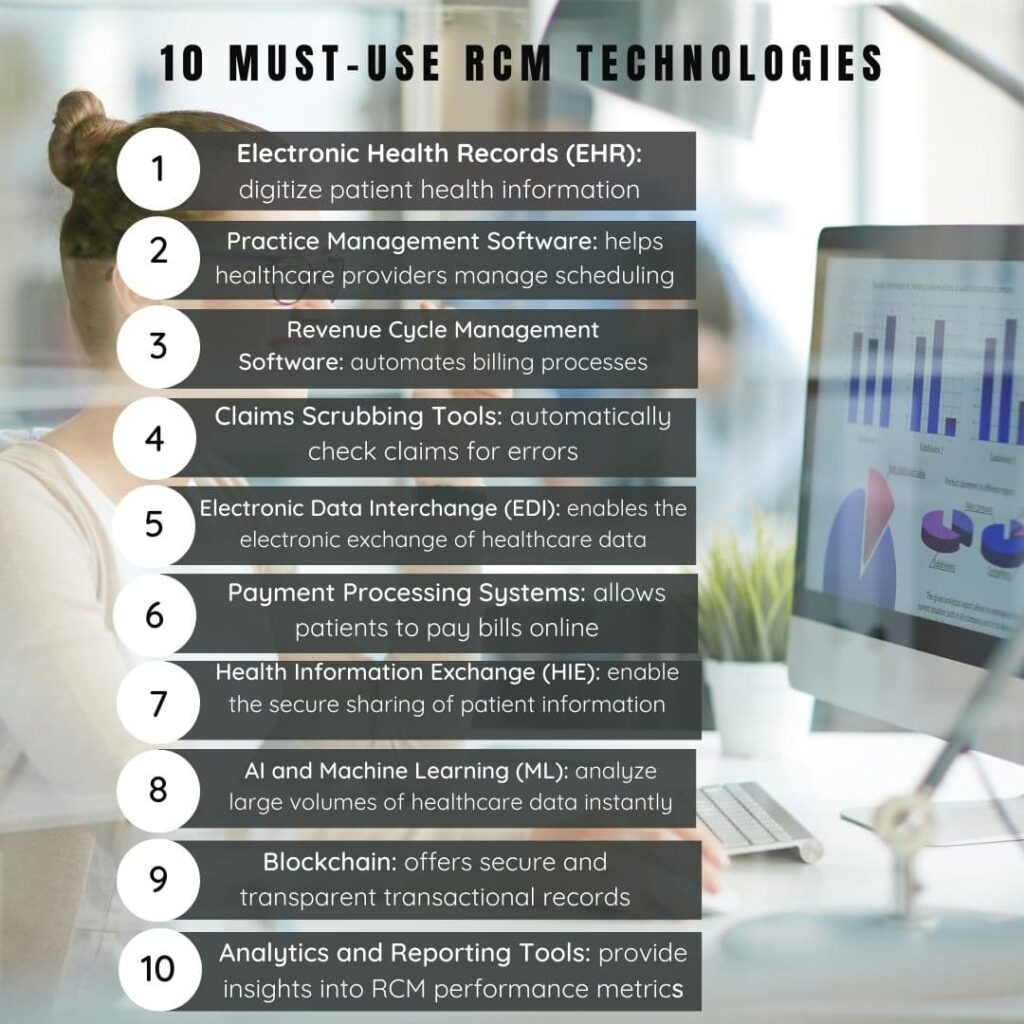
Technology is revolutionizing RCM practices in the current fast-paced healthcare sector. Employing this is advantageous to both healthcare providers and patients. Let’s discover some of the advancements you can make or your RCM service provider will employ:
Electronic Health Records (EHRs)
| Benefits of EHR System | Description |
| Improved Data Accuracy | EHR systems reduce errors associated with manual data entry, leading to more accurate billing. |
| Streamlined Workflow | Integration of EHR with RCM processes streamlines administrative tasks, reducing inefficiencies. |
| Enhanced Revenue Capture | EHRs help capture all billable services and ensure proper coding, maximizing revenue generation. |
| Expedited Claims Processing | Automated data retrieval from EHR speeds up claims processing, resulting in faster reimbursements. |
| Comprehensive Patient Information | Access to patient records in EHR facilitates accurate billing by providing comprehensive data. |
| Better Communication with Payers | EHR systems enable electronic submission of claims and documentation, improving payer communication. |
| Facilitated Denials Management | Detailed documentation in EHR aids in resolving denials by providing evidence of services rendered. |
| Improved Compliance and Reporting | EHRs assist in meeting regulatory requirements and generating compliance reports for auditing purposes. |
| Enhanced Patient Engagement | Access to EHR empowers patients to review their health records and understand billing information. |
| Support for Value-Based Care Models | EHRs provide data necessary for value-based care initiatives, supporting quality reporting and outcomes. |
The medical histories and treatment plans of patients are stored electronically in EHRs. By enhancing patient care coordination and streamlining data availability, they have revolutionized RCM.
With EHRs, healthcare professionals may easily access vital patient data. It reduces the need to trawl through paper records and improves the effectiveness of the billing procedure.
Billing Systems
The foundation of revenue cycle management is billing systems, which fully automate the entire cycle. Billing solutions streamline and optimize the financial workflow.
It saves immense time and lowers manual errors, from claim creation through submission and payment tracking. This technology ensures that healthcare professionals are paid accurately and on time for the services they perform.
Data Analytics Tools
By analyzing massive information and offering insightful analyses and trends, data analytics technologies play a crucial part in healthcare revenue cycle management.
These RCM technologies assist healthcare providers in identifying opportunities for development and evaluating the financial performance of their businesses.
Expect Increased ROI when Partnering with RCM Companies
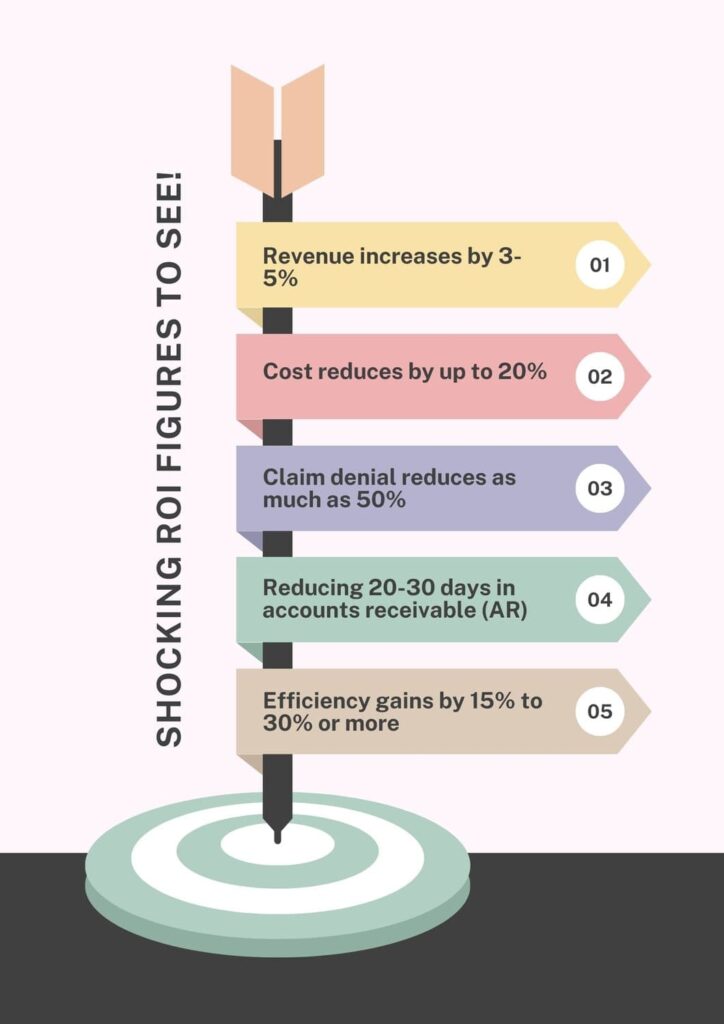
Financial security and operational effectiveness are essential for healthcare providers.
What is the return on investment (ROI) that providers can anticipate from collaborating with leading RCM firms? Revenue cycle management services are essential for guaranteeing efficient financial operations.
Let’s explore the benefits of RCM services and how they might assist healthcare providers in maximizing their profits.
1. Increased Revenue Collection
Revenue collection for healthcare providers can improve significantly as a result of collaboration with leading RCM firms.
Industry statistics show that when providers optimize their RCM with professional help, they can expect an average revenue growth of 5% to 10%.
Accurate claim filing, fewer denials, and prompt reimbursement processing are the causes of this increase in revenue.
2. Reduction in Operating Costs
Effective RCM services save administrative work and streamline financial procedures. According to studies, healthcare providers can save operational expenses by up to 20% by outsourcing RCM.
In addition to enhancing operational efficiency, this decrease in physical labor frees up resources for providers to devote to patient care and raises the standard of services as a whole.
3. Optimized Cash Flow
Healthcare providers benefit from an optimized cash flow thanks to prompt and accurate revenue collection, effective billing, and claims administration.
Research shows that when providers implement effective revenue cycle management solutions, their cash flow can improve by 15%. Providers may make wise financial decisions to improve their facilities when they have a predictable cash flow.
4. Improved Billing Accuracy
To assure billing accuracy, top revenue cycle management companies use cutting-edge billing technologies and electronic health information.
According to studies, putting in place an EHR system can cut down on billing errors by up to 86%.
The likelihood of claim denials and revenue loss due to billing errors is decreased as a result of the increase in billing accuracy, which also improves overall financial performance.
5. Enhanced Patient Satisfaction
Experiences with billing that are easy and clear have a favorable effect on patient satisfaction. Nearly 80% of patients who participated in patient surveys said they valued straightforward and accurate billing procedures.
RCM services that put the needs of the patient first produce happier clients who are more likely to refer other people to the healthcare provider, eventually boosting patient loyalty and retention.
6. Efficient Denials Management
Leading RCM firms use proactive denials management techniques.
Up to 90% of claim denials, it is estimated by the industry, are avoidable. RCM professionals greatly minimize the number of claim denials through thorough denials management, resulting in fewer revenue losses and more successful claim resubmissions.
7. Data-Driven Decision Making
RCM services offer healthcare providers in-depth financial reports and analytics.
The Healthcare Financial Management Association (HFMA) conducted a study that found that providers who employ data analytics in their RCM reduce accounts receivable days by 5% and the cost of collection by 20%.
8. Enhanced Compliance and Risk Management
Top RCM firms place a high priority on adhering to industry standards and healthcare laws. The American Medical Association (AMA) estimates that billing and coding mistakes can jeopardize up to 30% of healthcare income.
RCM services protect financial stability by employing strict risk management procedures that lessen the possibility of penalties or fines for non-compliance.
9. Focus on Core Competencies
Healthcare providers may concentrate on their core competencies—providing high-quality patient care—by collaborating with top revenue cycle management companies.
RCM experts take care of complex financial procedures, freeing providers to focus on providing excellent care and ensuring patient satisfaction.
10. Long-Term Financial Stability
Healthcare providers who invest in RCM services are guaranteed long-term financial stability.
Nearly 80% of hospitals that outsource RCM reported improvements in their finances, according to a study by Black Book Research.
A stronger financial base for the organization may result from ongoing improvements in revenue collection and financial performance.
What Things To Look For In An RCM Firm?
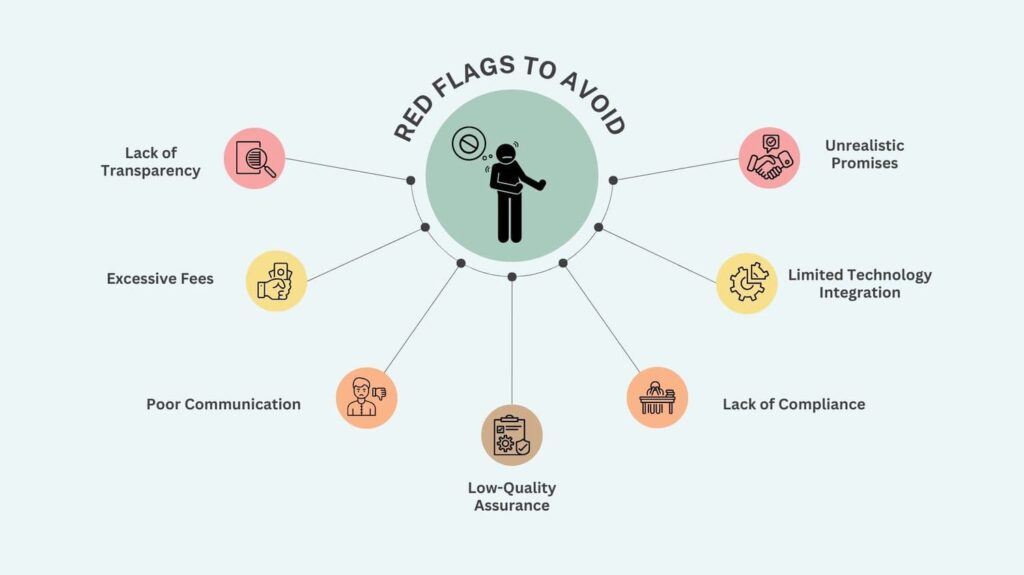
Though all firms mentioned here are professional and expert in conducting the RCM cycle, there are still criteria that every RCM firm needs to satisfy.
In order to consider any organization to collaborate with, here are the following things to make sure of:
- First, you must research how many years a company has been providing its RCM cycle services. The more the years, it means the more knowledge and expertise they have.
- Verify that the company you choose must have the original certificate of ISO 9001. This certificate proves the authority of a firm.
- You must also ensure how many clients they have worked with in the past and their satisfaction level. This refers to their portfolio. Check the number of customers they have served and how they helped them in routine RCM cycle tasks.
- Another important thing to make sure of is a firm’s claim denial ratio. We know no one is going to provide you with accurate data about their claim denials, as it can harm their reputation. But it is still crucial to get denial the data in hand.
- Meet the team that will work on your RCM cycle and claims. Make sure they have enough skills and experience to handle your tasks.
- Last but not the least, you must consider the fees of a firm before signing the contract. Compare various RCM cycle companies and choose one that offers the most reasonable package.
The Future of RCM Cycle Companies: Predictions and Innovations for 2026 and Beyond
The Revenue Cycle Management (RCM) industry is positioned for new breakthroughs and technologies that will reshape the way healthcare is billed in the future.
RCM Cycle Companies are anticipated to be crucial in optimizing medical billing procedures and improving patient experiences in 2026 and beyond.
Here are some key performance indicators (KPIs) that are already used to measure the efficiency of RCM but will be more crucial in future:
| Performance Metric | Description |
| Clean Claim Rate | Percentage of claims submitted without errors or rejections |
| Days in Accounts Receivable | Average number of days it takes to collect payments |
| First Pass Resolution Rate | Percentage of claims resolved on the first submission attempt |
| Collection Rate | Percentage of billed charges collected from payers and patients |
| Denial Rate | Percentage of claims denied by payers |
| Accounts Receivable Turnover | Frequency of converting outstanding AR into cash |
| Patient Payment Collection Rate | Percentage of patient balances collected |
Let’s look at some of the most important forecasts and developments that are expected to influence their future.
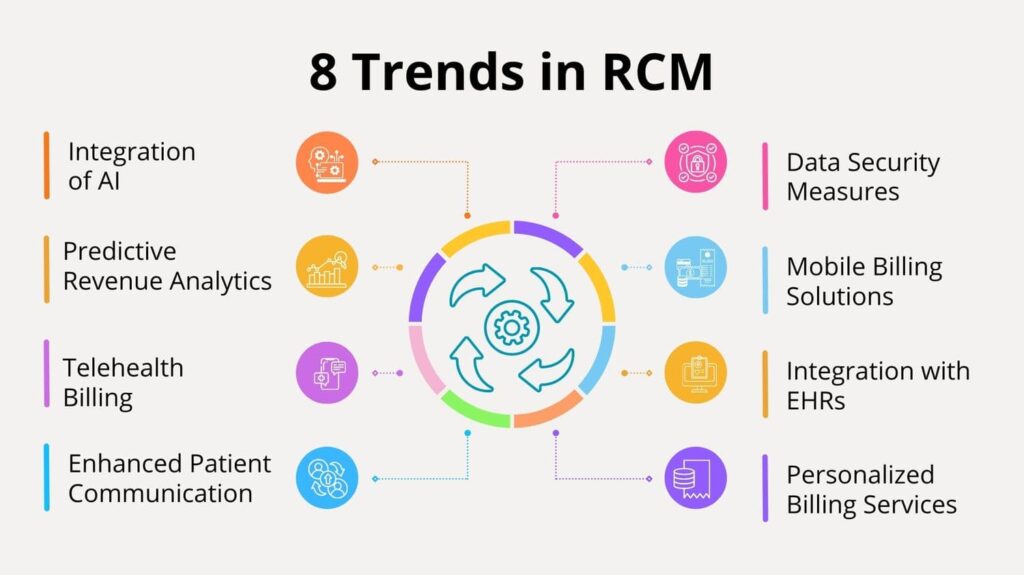
Integration of Artificial Intelligence (AI)
RCM Cycle Companies utilize AI to automate monotonous operations like processing claims and payment follow-ups. AI algorithms are going to be advanced, which will result in quicker and more precise billing processes.
Predictive Analytics for Revenue Optimization
These companies will use predictive analytics to examine past data. This way they will estimate revenue trends and spot potential billing difficulties before they arise.
Healthcare providers’ revenue streams will be optimized by this proactive strategy.
Telehealth Billing Solutions
RCM cycle companies will provide specialized billing options for virtual care as telehealth services continue to expand.
They will guarantee smooth invoicing procedures for remote medical services and telehealth consultations.
Enhanced Patient Communication and Education
These firms will prioritize enhancing patient education and communication about medical billing. Patients are better able to grasp their financial obligations and make wise decisions if there is open and honest communication.
Data Security and Privacy Measures
RCM companies will invest in robust security measures as data breaches become a concern to protect patient information and guarantee adherence to privacy laws.
Mobile Billing Solutions
RCM Cycle companies will create cutting-edge mobile billing applications that will let patients effortlessly access billing data, make payments, and track claims through their cell phones.
Integration with Electronic Health Records (EHRs)
RCM companies will access patient data quickly. They will streamline billing procedures thanks to the increasing prevalence of seamless connectivity with EHR systems.
Personalized Billing Services
In order to provide specialized billing services that meet the specific demands of each healthcare provider, these companies will base their offerings on those needs.
Sustainability Initiatives
Some RCM companies will employ eco-friendly billing systems. This way they will reduce their use of paper in order to contribute to environmental preservation.
AI-Powered Denial Management
Denial management solutions powered by AI will effectively identify and address claim denials, minimizing reimbursement processing times and maximizing revenue flow.
Your Guide To Choosing An RCM Company
With the help of our detailed guide, you are now in a better position to pick an RCM cycle management company that not only manages your claims but also helps you secure adequate revenue.
A stronger financial base for the organization may result from ongoing improvements in revenue collection and financial performance.
The Bottom Line
Choosing the right revenue cycle management company is a critical decision that can significantly impact the financial success of your healthcare organization.
By considering factors such as location, staff size, and past revenue figures, you can make an informed choice.
These top 15 revenue cycle management companies offer a range of expertise, services, and solutions to streamline your revenue cycle, optimize financial outcomes, and enhance operational efficiency.
By partnering with one of these reputable companies, you can focus on delivering quality healthcare while ensuring a healthier bottom line.
| RCM Challenges | Solutions |
| Complex Payer Contracts | Contract management software, negotiation support services. |
| High Denial Rates | Denials analytics tools, staff training on coding and billing. |
| Inefficient Processes | Workflow optimization consulting, automation solutions. |
| Compliance Risks | Compliance auditing services, regulatory compliance software. |
| Staffing Shortages | Outsourcing RCM services, temporary staffing solutions. |
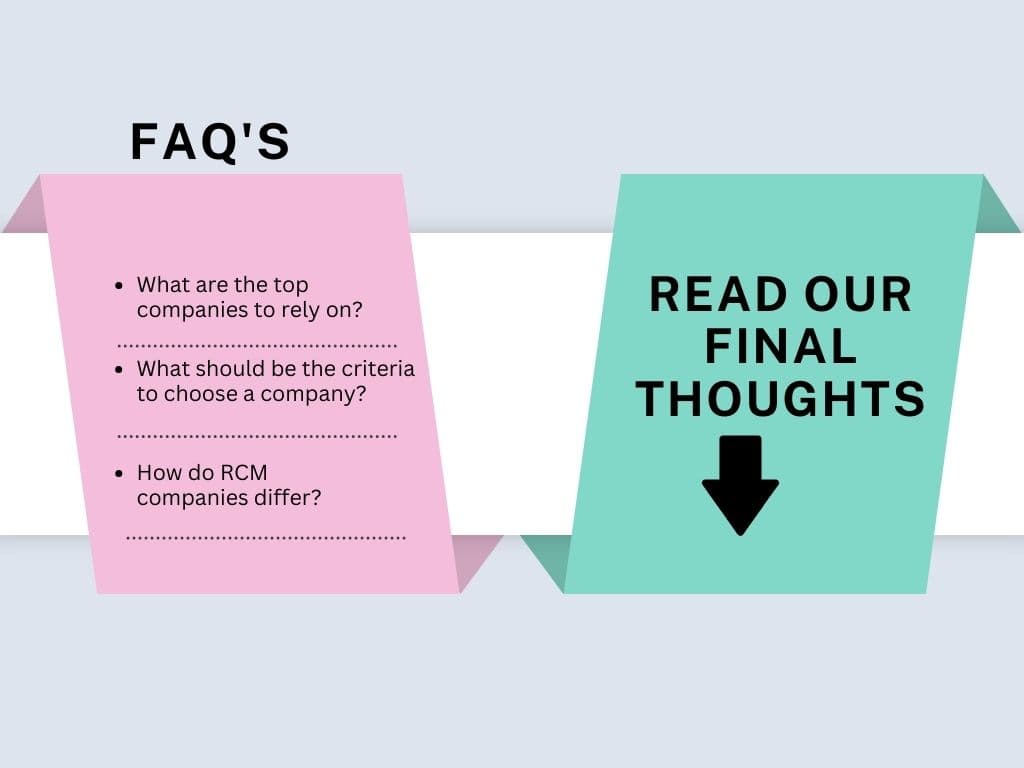
Faq’s
What are the top revenue cycle management companies we can rely on?
A- Although there are a number of RCM companies, based on our extensive research we have chosen the following best one from them:
- General Electric Company
- Siemens Healthineers
- Accenture
- Access Healthcare
- AccessOne
- Epic Systems
- Quest Diagnostics
- McKesson Corporation
- Abeo
- Cerner Corporation
What criteria to keep in mind when choosing a company?
A- The following are the criteria on the basis of which you should analyze and pick an RCM firm:
Experience: This is the first thing to keep in mind when choosing a company. See how many years of diversified experience they possess.
Expertise: Make sure the company masters and provides services to all the aspects of RCM.
Technology and software: The company must be able to use updated technology as the healthcare industry keeps changing.
Compliance: They must follow the industry rules and regulations.
Customization: The company must be able to adapt to your healthcare facility to serve your patients and insurance payers better.
Cost and pricing: Last but not least, you must ask for the monthly and yearly contract fees, along with any extra charges.
Are there different types of RCM companies? How do they differ?
A- Based on specialization, each company differs in the service they provide. The service areas that make each company unique are:
- Billing and Coding
- Accounts receivable management
- Eligibility verification
- Patient payment solutions
- Denial management
- Revenue cycle consulting
- Full RCM outsourcing